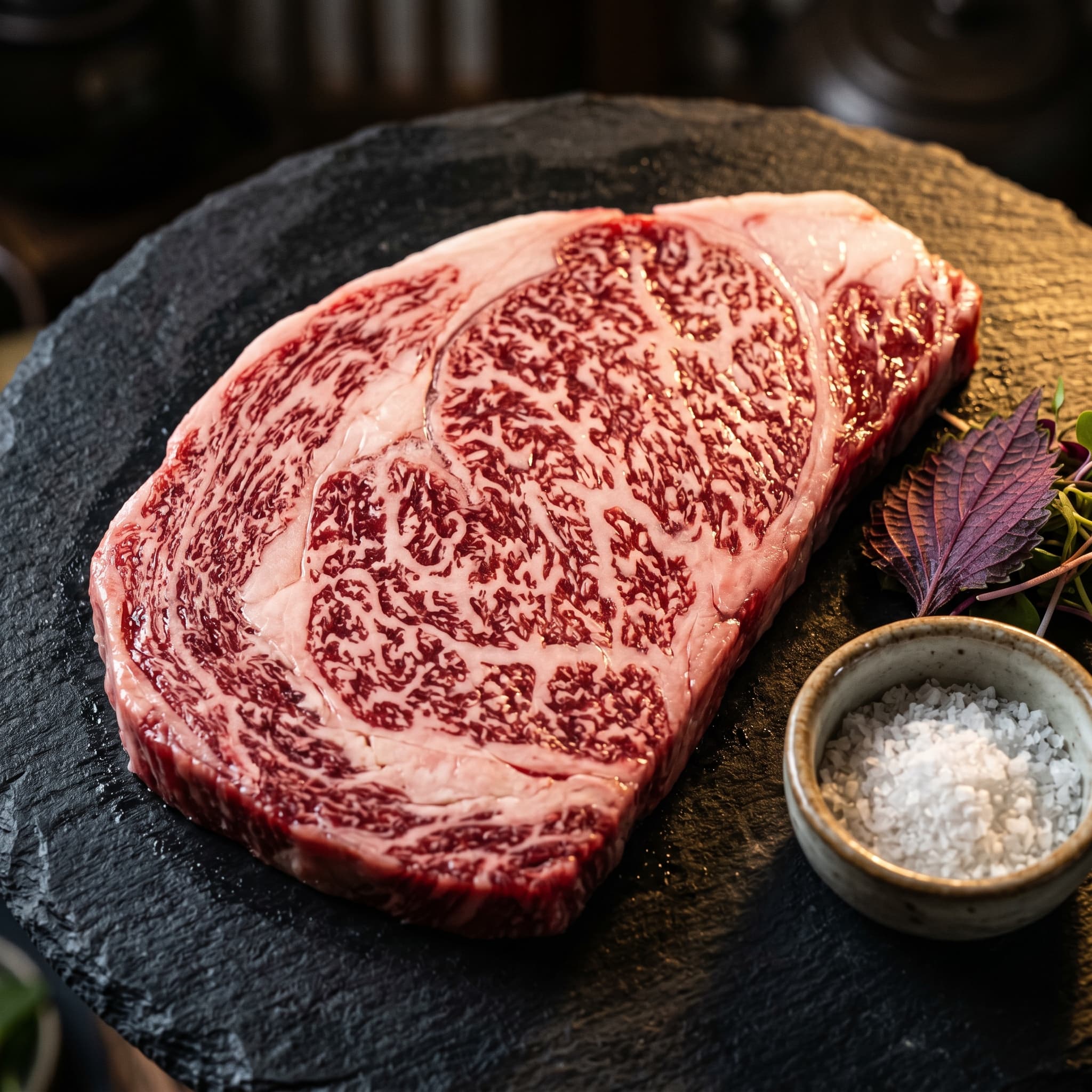
The marking most people look for on Korean beef is 1++. Yet two restaurants can both say 1++ and charge nearly double one another. Nobody is cheating. There are further grades inside 1++.
Korean beef is graded on two scales
- Quality grade: 1++ · 1+ · 1 · 2 · 3 — marbling, meat colour, fat colour, texture
- Yield grade: A · B · C — how much meat the carcass gives
What you see in a restaurant is almost always the quality grade, and 1++ is the top.
And 1++ splits again
To reach 1++, marbling has to pass a threshold. Above that line it is divided further into No.7, No.8 and No.9.
| Quality grade | Marbling score |
|---|---|
| 1++ | No.9 · No.8 · No.7 |
| 1+ | No.6 |
| 1 | No.5 · No.4 |
| 2 | No.3 · No.2 |
| 3 | No.1 |
These divisions come from the detailed grading criteria in the Enforcement Rules of Korea's Livestock Industry Act. The full set of criteria and the cut examined is laid out on our Hanwoo nutrition and grading page.
So 1++ No.7 and 1++ No.9 are both 1++ but are visibly different cuts of meat. That is where the price gap comes from.
If a menu just says "1++", it could be either. You can simply ask: "What number?"
Is No.9 always better
Denser marbling means a softer, richer bite. Preference splits, though.
- No.9: melts in the mouth. Can feel heavy over a long meal
- No.7–8: more chew, more beef aroma
There is no correct answer. What is certain is that at the same price, No.9 is the more expensive beef.
What the grade does not tell you
Grading happens at slaughter. What you taste is decided afterwards.
- Ageing: how many days, and how
- Cut: ribeye and brisket differ on the same animal
- Trimming: how sinew and hard fat were removed
- Storage: display condition and temperature
This is why a restaurant where you can see the meat has an advantage. When it sits in a display case, you can check the marbling and the colour yourself.
At Hanwoo Gojip
Only 1++ No.9 goes into our case, every day. No.7 and No.8 don't.
This is a sigyuksikdang, a butcher-style restaurant: you choose your own cut from the case, and we weigh it in front of you, the stated cut at the stated weight. The grade isn't a claim, it's something you look at.
Prices start at ₩18,000 per 100g; ribeye and galbisal are ₩22,000 per 100g. We have held this standard in Gaya-dong, Busan for twenty years.
📍 HANWOO GOJIP Busan Gaya
- 134 Eomgwang-ro, Busanjin-gu, Busan (Gaya-dong 490), 1F & 2F
- +82 51-891-9777
- Mon–Fri 15:00–22:00 / Sat–Sun 11:00–22:00 (L.O. 21:30)
- See the menu →